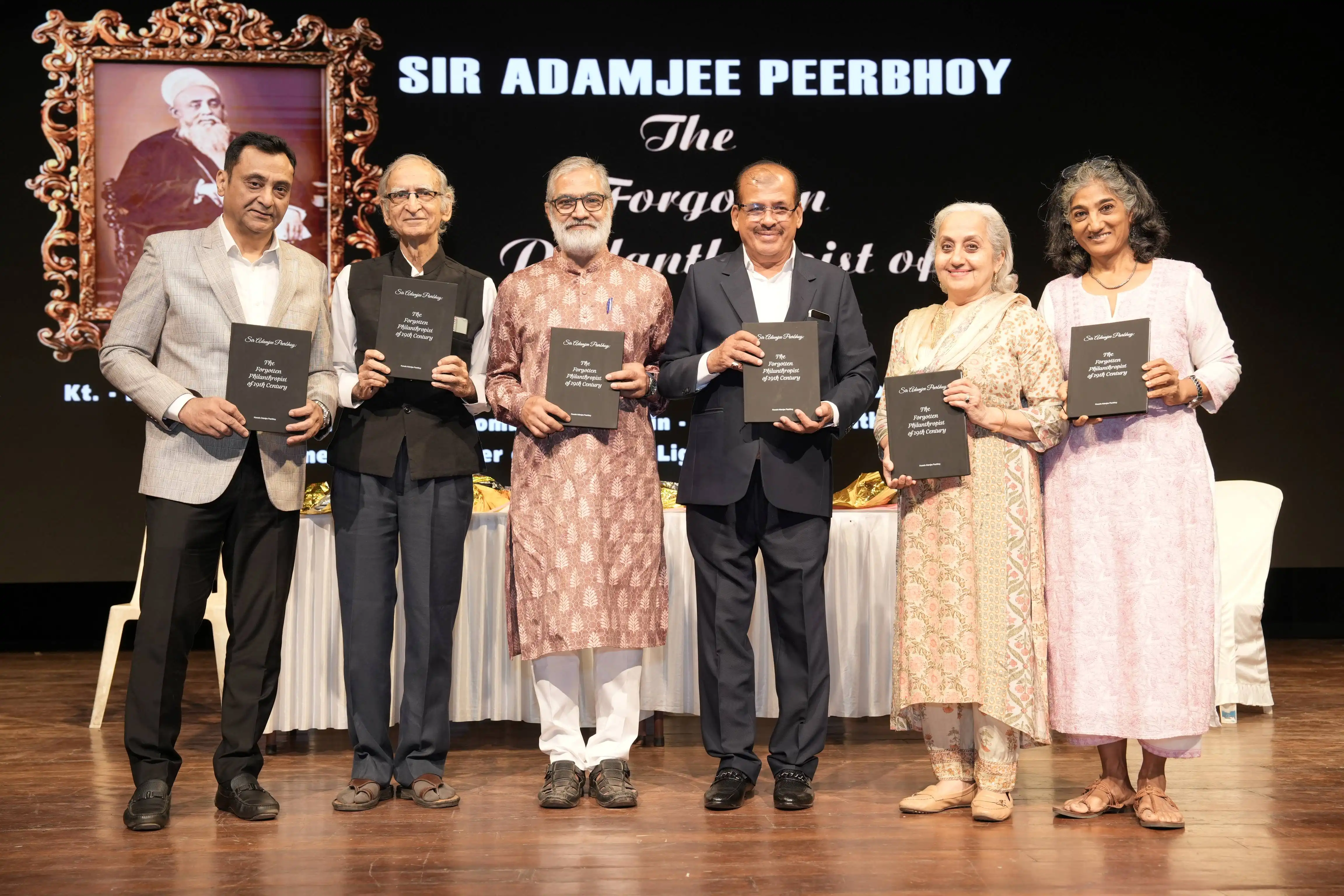
In a city that often forgets its earliest architects, the story of one of Bombay’s most extraordinary yet overlooked figures is set to be retold. The book ‘Sir Adamjee Peerbhoy: The Forgotten Philanthropist of the 19th Century’, authored by his great-grandson Hussain Adamjee Peerbhoy, was unveiled at St. Andrew’s Auditorium, Bandra, in the presence of Sohail Khandwani (Managing Trustee, Mahim Dargah & Haji Ali Dargah), Dr. Ram Puniyani (author and peace activist), Irfan Engineer (General Secretary, Central Board of the Dawoodi Bohra Community), Hussain A. Peerbhoy (author), Rajni Bakshi (author and peace activist), and Geeta Seshu (writer), bringing back into public memory a man who once shaped the very soul of the city.
Long before organised charity became institutionalised, Sir Adamjee Peerbhoy stood apart as a rare force of generosity and vision. Born in 1846 in Dhoraji, Gujarat, he arrived in Bombay as a teenager with just five rupees in his pocket. What followed was nothing short of extraordinary! By his early twenties, he had established himself as a formidable businessman, even building the iconic Peerbhoy Palace on Malabar Hill then, as now, among the city’s most elite addresses, located right next to Varsha Bungalow - the office of the Honourable Chief Minister of Maharashtra.
But it was not wealth that defined him… it was what he chose to do with it…
At a time when philanthropy was neither expected nor widespread, Sir Adamjee quietly transformed lives across communities. He established over two dozen schools educating thousands of children, built hospitals and dispensaries, supported women’s healthcare, and funded relief efforts during famines and disasters across India and beyond. His contributions extended internationally, from creating rest houses in Mecca and Medina to aiding distressed regions in Yemen and Arabia.
Among his most enduring legacies was his role in the development of public infrastructure, including the historic Matheran Light Railway, and his appointment in 1897 as the first Indian Sheriff of Bombay, a milestone that reflected both his stature and the trust he commanded.
His contributions did not go unnoticed in his lifetime. Among many awards and accolades, the British Crown also conferred upon a Knighthood in 1907, recognising both his business acumen and far-reaching philanthropic work.
Yet, despite such monumental contributions, his name has faded from mainstream memory…
This new multi-volume biography seeks to change that.
“For me, this book is not just a tribute… it is the fulfilment of a legacy,” shared Hussain Adamjee Peerbhoy, whose father had first begun documenting the family’s history decades ago. “It was always his wish to bring these remarkable lives into the limelight. I have only carried that responsibility forward to restore my great grandfather, Sir Adamjee Peerbhoy, to public memory and to inspire a younger generation through the example of a life led with humility, purpose and quiet generosity.”
The book is expansive in scope, combining historical narrative with personal archives. It revisits an earlier work on the Matheran Light Railway, traces Sir Adamjee’s life in detail, and explores his close association with the spiritual leaders of the Dawoodi Bohra community - relationships rooted in humility and service.
What makes the book particularly contemporary is its format. The book integrates audio-visual elements through QR codes, allowing readers to access documentaries and visual narratives that bring the 19th century vividly alive. “I wanted people to experience his life, not just read about it,” Hussain Peerbhoy explained, crediting his daughter-in-law for helping bring this idea to life.
In the course of his research, the author uncovered lesser-known facets of his great-grandfather’s character, like his intent to build a veterinary hospital for animals, reflecting a compassion that extended far beyond human need. Taking that intent further, Hussain Adamjee and his family started a free English-medium school at the foothills of Matheran - an initiative that has since enabled students from rural backgrounds to build professional careers.
More than a historical account, the book also raises a timely question: what does philanthropy mean today? “His charity was never limited by caste, creed or community. He helped anyone in need whether through education, healthcare or basic survival,” said Hussain Peerbhoy. “And, in today’s divided world, that spirit feels more relevant than ever,” he added.