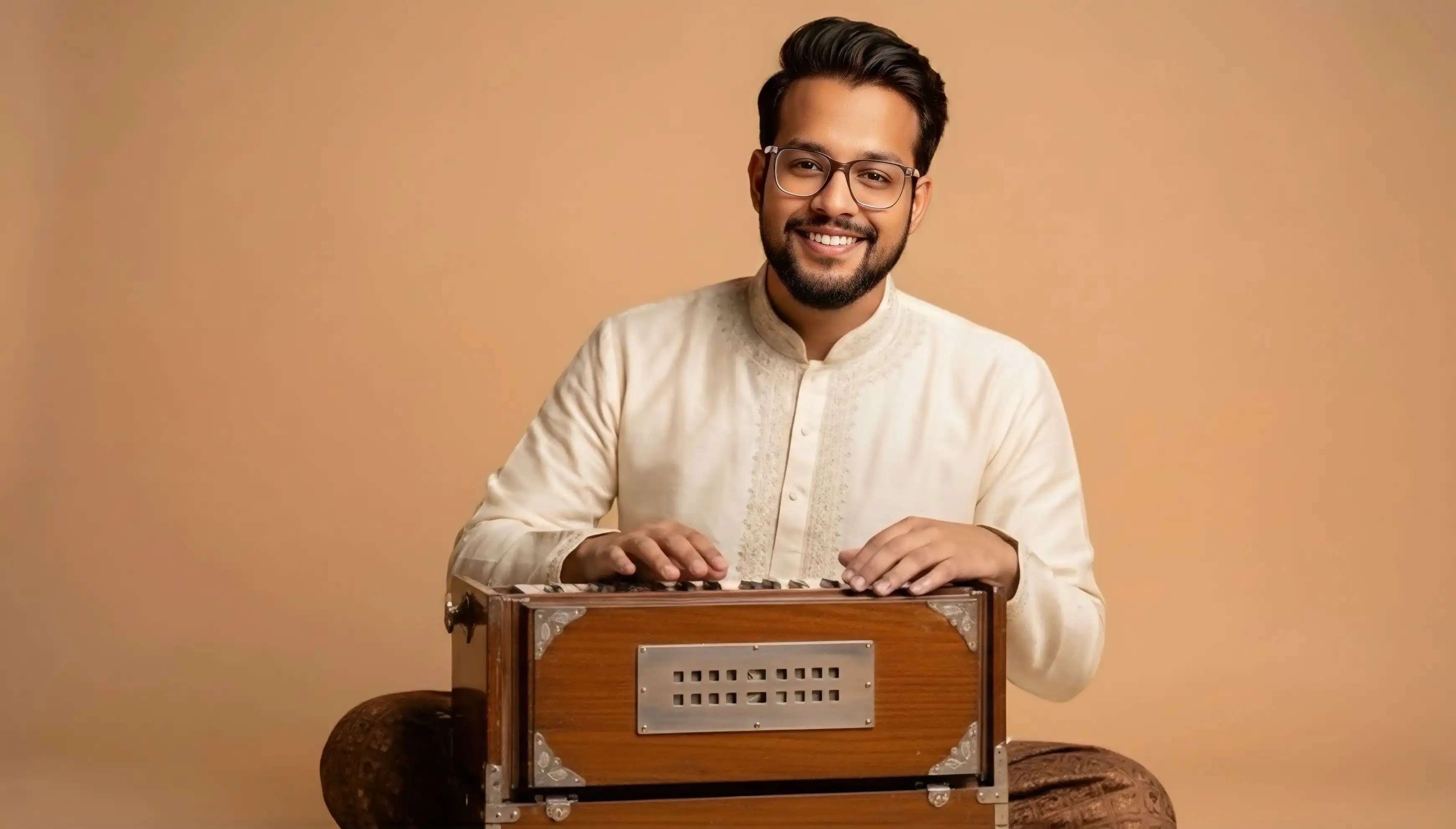
For Sadakat Aman Khan, music was never a choice—it was the air he breathed. Raised in Malda in a family where riyaaz began before sunrise and conversations flowed through raags and poetry, he inherited not just skill but a philosophy. As the grandson of Sangeetacharya Ustad Md. Yunus Khan and the son of Ustad Sahadat Rana Khan, Sadakat absorbed discipline, emotion and devotion long before his fingers first touched a harmonium key., Today, after years of performing worldwide and authoring Gharanas of Indian Music, he stands at a rare crossroads: deeply rooted in lineage, yet fearless in exploring new musical landscapes. Living in London has expanded his artistic world while also deepening his connection to home. In this honest conversation, Sadakat reflects on his childhood, the moment he felt the harmonium “breathe, ” the misconceptions surrounding gharanas, the healing power of music, and the delicate balance between innovation and tradition., Here’s our conversation with harmonium maestro Sadakat Aman Khan.
What was your childhood like? Who in your family influenced your musical journey the most?
My childhood in Malda was quiet, simple and filled with music from morning to night. I grew up listening to my grandfather, Sangeetacharya Ustad Md. Yunus Khan, and my father, Ustad Sahadat Rana Khan, practising every day. Their dedication shaped everything I understood about discipline and emotion. They didn’t just influence my musical journey — they built the foundation of it.
Do you remember the first time you heard or touched a harmonium as a child?
Yes, very clearly. I was about four when I pressed a key for the first time. The sound felt warm, almost like the instrument was breathing. Even as a child, I felt a strange connection to it. That small moment was life-changing, because from then on I kept going back to the harmonium every day.

Were there any traditions or routines at home that strengthened your connection to music?
Music was part of our daily routine. My mornings began with my grandfather’s riyaaz and evenings often turned into small family mehfils. We would sit together, sing, talk about raags, poetry and stories of musicians. These moments made music feel natural and taught me that it’s not just practice — it’s a way of life.
When did you realise you wanted to take this tradition beyond India?
The realisation grew slowly as I performed outside India. I noticed how people from different cultures connected with the harmonium even without understanding the lyrics. Their curiosity and response made me feel that this tradition shouldn’t remain limited by geography. It inspired me to share it with the wider world.
How has living in London influenced your music?
London exposed me to new cultures and sounds, which opened my mind creatively. People here are very open to Indian classical music, and that encouraged me to experiment more — whether through fusion or new styles. At the same time, being away from home made me value my roots even more deeply.

Your book Gharanas of Indian Music explores tradition. What are some common misconceptions about gharanas?
People often think gharanas are rigid and never evolve, but that’s not true. Every gharana was born because someone brought something new to music. Innovation is the birth of every gharana.
Another misconception is that gharanas divide musicians or create competition. In reality, they are different approaches to the same art form — different colours of the same painting. A gharana is not only about technique; it is about philosophy, personality, and emotion. Many people don’t realise this.
In your TEDx Talk, you spoke about music as healing. What experiences shaped that message?
My own life showed me how healing music can be. During difficult family moments, or when I moved away from India, the harmonium became my support system. I’ve also received messages from listeners saying my music helped them with stress or loneliness. These experiences made me realise how deeply sound and emotion are connected.
What have you learned from performing with maestros like Ustad Shafqat Ali Khan?
Performing with maestros teaches you humility. From Ustad Shafqat Ali Khan, I learned that emotion is more important than technique and that every note should carry intention. Despite being such a respected figure, he treats the art with simplicity and respect.
Watching him prepare, rehearse, and interact with musicians taught me that real mastery comes with grace, not ego. He reminded me that music is meaningful only when you truly listen — it is a conversation, not a competition.

Which contemporary artists would you like to collaborate with in the future?
There are many. I would love to work with AR Rahman for his ability to blend tradition with modern sound. I admire Anoushka Shankar’s depth, and Ricky Kej’s global approach inspires me.
Outside India, I’m keen to explore collaborations in jazz, metal, or electronic music. I enjoy stepping outside my comfort zone and seeing how the harmonium adapts to different musical worlds.
What has been the most challenging part of your journey?
Balancing tradition and innovation has been the toughest. When you try something new, some question your commitment to classical music; when you stay traditional, others say you’re not evolving. Walking the middle path takes courage.
Another challenge is living away from home. Carrying your tradition alone in a foreign country isn’t always easy. But every challenge has helped me grow — as a musician and as a person.